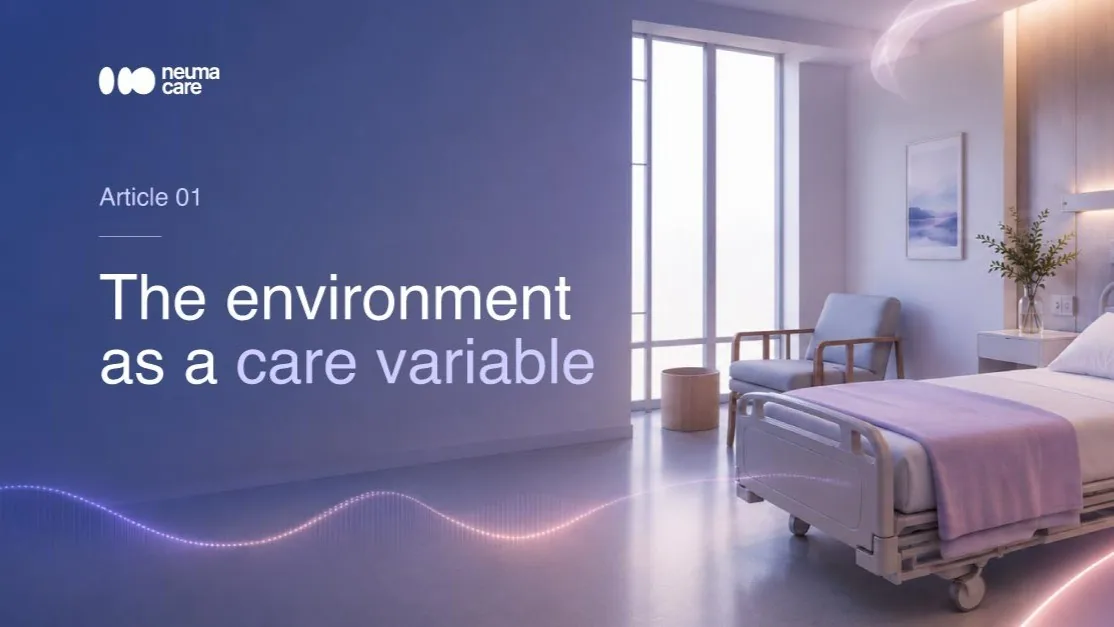
The environment as a care variable
When we talk about quality of care, we usually think about protocols, technology, or staffing ratios. Rarely do we consider what happens between clinical interventions — when the patient is alone — even though those hours can also support healing or interfere with it.
Noise
The World Health Organization recommends that nighttime noise levels in patient rooms should not exceed 30 dB(A) in order to support restorative sleep. However, studies conducted in real hospital environments have recorded nighttime peaks close to or above 100 dB(A). One recent study found that 40% of hospitalized patients reported sleeping poorly or very poorly, with noise identified as the main disruptive factor.
The nervous system can trigger an alert response to repeated acoustic stimuli, increasing cortisol levels and fragmenting deep sleep. In a clinical intervention conducted in an emergency observation area, reducing light and noise levels was associated with an increase from 72% to 91.37% in the number of patients who reported having rested well.
Small environmental changes can lead to major physiological improvements in sleep quality.
Invasive Light
Light is the main regulator of the circadian clock. Exposure to blue or intense light at inappropriate times suppresses melatonin secretion and disrupts the sleep-wake cycle, which is essential for cellular regeneration and immune modulation.
In a hospital, patients do not control when hallway lights are switched on or how intense the lighting is during nighttime rounds. The brain, however, still processes these stimuli and adjusts hormonal responses accordingly.
Designing hospital lighting is not merely an aesthetic decision. It is a direct intervention in circadian rhythms and patient recovery.
Hospital Smells
The sense of smell is directly connected to limbic structures involved in emotion and memory. This means that certain smells can activate or calm the nervous system within seconds, even before the patient becomes consciously aware of them.
Studies suggest that specific scents may support parasympathetic responses, reduce stress, and improve sleep quality. Yet in healthcare environments, smell remains a largely overlooked variable.
Rest and Biological Rhythms
Rest is an active physiological process in which the body repairs tissues, regulates hormones, and consolidates memory and emotions. When the hospital environment disrupts this cycle, it interferes with the very foundations of recovery.
Sound, light, and smell influence us whether we notice them or not. The difference lies in whether they support or interfere with patient recovery.
These variables can be measured. They can also be managed. The challenge is to start treating them as care variables rather than background conditions.
At NeumaCare, we work to better understand how sensory environments influence patient rest, and how these environments can adapt intelligently and dynamically to physiological rhythms in real time.
How does your organization currently manage patient rest and the sensory environment?
Sources
- 30 dB(A) nighttime noise recommendation — WHO Guidelines for Community Noise
- Nighttime peaks above 100 dB(A) — Adams et al., 2024
- 40% of patients sleeping poorly — Adams et al., 2024
- 72% → 91.37% improvement in reported rest — Ordozgoiti et al., 2017
- Light and circadian rhythm — Review on light, sleep and circadian rhythm
- Olfaction and the limbic system — Sullivan et al., 2015
- Date
- May 19, 2026
- Category
- Insights
- Reading time
- 3 min