Ambient intelligence in hospitals: can the environment anticipate patient needs?
A hospital room may recognise context and adjust selected conditions before discomfort escalates. That is very different from reading emotions or making a diagnosis—and it only works with privacy, cybersecurity and human control built in.
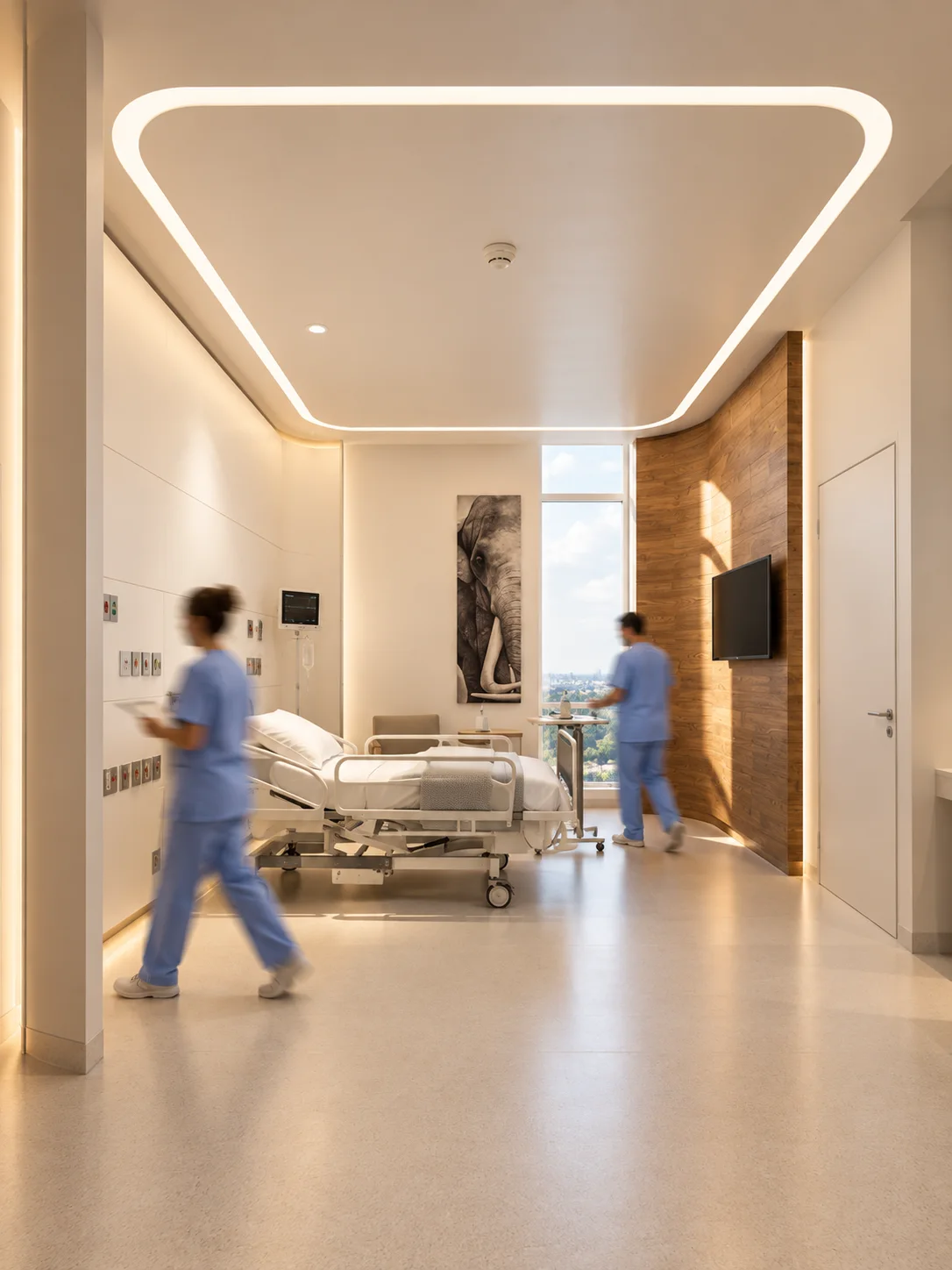
It can anticipate a narrow set of needs. A connected room may notice that nighttime noise has remained high or that the lighting no longer matches an agreed preference. Those signals do not tell it that the patient is anxious, in pain or developing delirium.
The useful ambition is not a room that “understands” people. It is an environment that detects relevant context, offers a proportionate response and checks what happened next.
From passive room to responsive environment
Ambient intelligence brings together sensors, contextual information, decision logic and an action. The action might be a prompt, a question or an automatic adjustment within pre-approved boundaries.
Sensors can measure illuminance, sound level, temperature, humidity, air quality or occupancy. Context may include time of day, room function, a care activity and a consented preference. Machine learning is optional: a transparent, tested rule may be safer than a complex model.
A 2023 scoping review of context-aware medical systems found that location, activity, time and patient history were among the contexts already being used. Sensing them is the easy part. Turning them into a response that helps rather than interrupts is harder.
What could a room realistically anticipate?
A tightly defined system might:
- identify sustained acoustic load and suggest a night setting;
- adapt light gradually to time and a recorded preference;
- flag environmental conditions outside an agreed range;
- pause a sensory programme when care begins or an alarm takes priority;
- recall a previously accepted setting and ask before applying it again.
This is environmental anticipation, not clinical prediction. A review of ambient intelligence in healthcare described considerable potential to support care, while a 2024 review of AI-supported continuous monitoring found discrepancies between promised capabilities and actual evidence. A more comfortable room may be worthwhile. It does not, on its own, prove faster recovery, fewer medicines or a shorter stay.
Sensors produce estimates, not ground truth
A device can drift, lose calibration, be obstructed or assign an event to the wrong occupant. Stillness does not always mean sleep; quiet does not necessarily mean calm; and a sudden increase in light or sound may reflect necessary care.
Teams therefore need to measure both false positives and missed needs. Excessive prompts create alert burden. An AHRQ rapid review of patient monitoring systems found no consistent improvement from early-warning systems alone. Its focus was clinical monitoring, but the design lesson travels well: pattern detection is useful only when it leads to a timely, understandable action.
Privacy and cybersecurity are clinical safeguards
The safest data are often the data never collected. A device may calculate sound pressure locally without retaining speech. Occupancy may be estimated without facial identification. An event or summary may be enough, rather than continuous raw data.
Data protection by design and by default means settling purpose, lawful basis, access, retention, transparency and individual rights before deployment. Removing a name does not automatically make room-level data anonymous.
Connected environments also need asset inventories, network segmentation, strong authentication, encryption, logging, update processes and incident plans. Safe failure matters: a lost connection must not leave lighting, ventilation or sensory outputs in a hazardous state. ENISA’s work on the health sector highlights the exposure created by vulnerable connected systems and supply chains.
Bias, false certainty and human oversight
A model developed in one ward may fail in another. Data dominated by mobile, verbally communicative patients in single rooms may not represent people with limited mobility, cognitive impairment, neurodivergence or different ways of expressing discomfort.
Performance should be tested locally and prospectively, with subgroup results and post-deployment monitoring. Silence must never be treated as consent, nor low movement as proof of comfort.
A practical governance model separates three levels: automatic changes within safe environmental limits; suggestions requiring confirmation; and clinical decisions reserved for professionals. Every level needs a visible override and a clear account of what the system changed.
Regulation follows function, not the word “smart”
Not every AI system used in a hospital is automatically high-risk, and not every connected room is a medical device. The applicable legal category depends primarily on intended purpose. For AI linked to a medical device, the device classification and whether third-party conformity assessment is required also matter.
Comfort-oriented lighting control is different from software intended to detect deterioration, guide treatment or treat insomnia. A medical purpose may bring the EU Medical Device Regulation into scope and, depending on classification, high-risk obligations under the AI Act. GDPR and cybersecurity duties may apply independently. The 2025 European FAQ on the MDR–AI Act relationship confirms that several frameworks can apply to one product.
This is why regulatory, data-protection, clinical-engineering and security teams should help define the intended use—not review it after marketing claims have been written.
Start with a learning pilot
A responsible first deployment can be small:
- Choose one environmental problem and exclude diagnostic use.
- Map data, risks, owners and less intrusive alternatives.
- Run in shadow mode: observe without changing the room.
- Measure accuracy, false prompts, missed events, subgroup performance and staff burden.
- Enable one reversible action with boundaries and manual override.
- Scale only if experience improves without introducing a new safety risk.
NeumaCare is exploring how care environments can become responsive while keeping people in control. If your organisation wants to frame a measurable, governable pilot, get in touch.
Frequently asked questions
Does ambient intelligence require cameras or microphones?
No. The least intrusive sensor that can meet the stated purpose should be preferred. Light, temperature, presence or aggregated sound-level sensors may be enough. Audio and video require particularly strong justification.
Can it detect patient anxiety?
Environmental or behavioural signals cannot establish an anxiety diagnosis. Making that claim would create a different medical use case requiring clinical evidence, validation in the intended population and regulatory assessment.
What can be safely automated?
Pre-authorised, reversible adjustments within validated environmental limits. When confidence is low, care is under way or an action could carry clinical consequences, the system should ask rather than act.
Are data anonymous once the patient’s name is removed?
Not necessarily. Room, time, device and movement patterns may identify someone when combined with other records. Privacy assessment must consider the complete data flow and re-identification risk.
Sources and further scientific reading
- Haque A, Milstein A, Fei-Fei L. (2020). Illuminating the dark spaces of healthcare with ambient intelligence. Nature.
- Zon M, Ganesh G, Deen MJ, Fang Q. (2023). Context-Aware Medical Systems within Healthcare Environments: A Systematic Scoping Review to Identify Subdomains and Significant Medical Contexts. International Journal of Environmental Research and Public Health.
- Aagaard N, Aasvang EK, Meyhoff CS. (2024). Discrepancies between Promised and Actual AI Capabilities in the Continuous Vital Sign Monitoring of In-Hospital Patients. Sensors.
- Winters BD et al. (2024). Patient Monitoring Systems To Prevent Failure To Rescue: Rapid Review. Making Healthcare Safer IV, Agency for Healthcare Research and Quality.
- Lindroth H et al. (2024). Applied Artificial Intelligence in Healthcare: A Review of Computer Vision Technology Application in Hospital Settings. Journal of Imaging.
- World Health Organization. (2023). Regulatory considerations on artificial intelligence for health.
- WHO Regional Office for Europe. (2025). Health data governance in the age of artificial intelligence.
- European Data Protection Board. Data protection by design and by default.
- European Union Agency for Cybersecurity. Health-sector cybersecurity.
- Artificial Intelligence Board and Medical Device Coordination Group. (2025). MDCG 2025-6: Interplay between the MDR/IVDR and the Artificial Intelligence Act.