The patient’s body clock: how hospital lighting shapes sleep, mood and recovery
Light tells the brain when to be alert and when to prepare for sleep. In hospital, protecting that signal may support rest and wellbeing—but claims of faster clinical recovery need much stronger evidence.
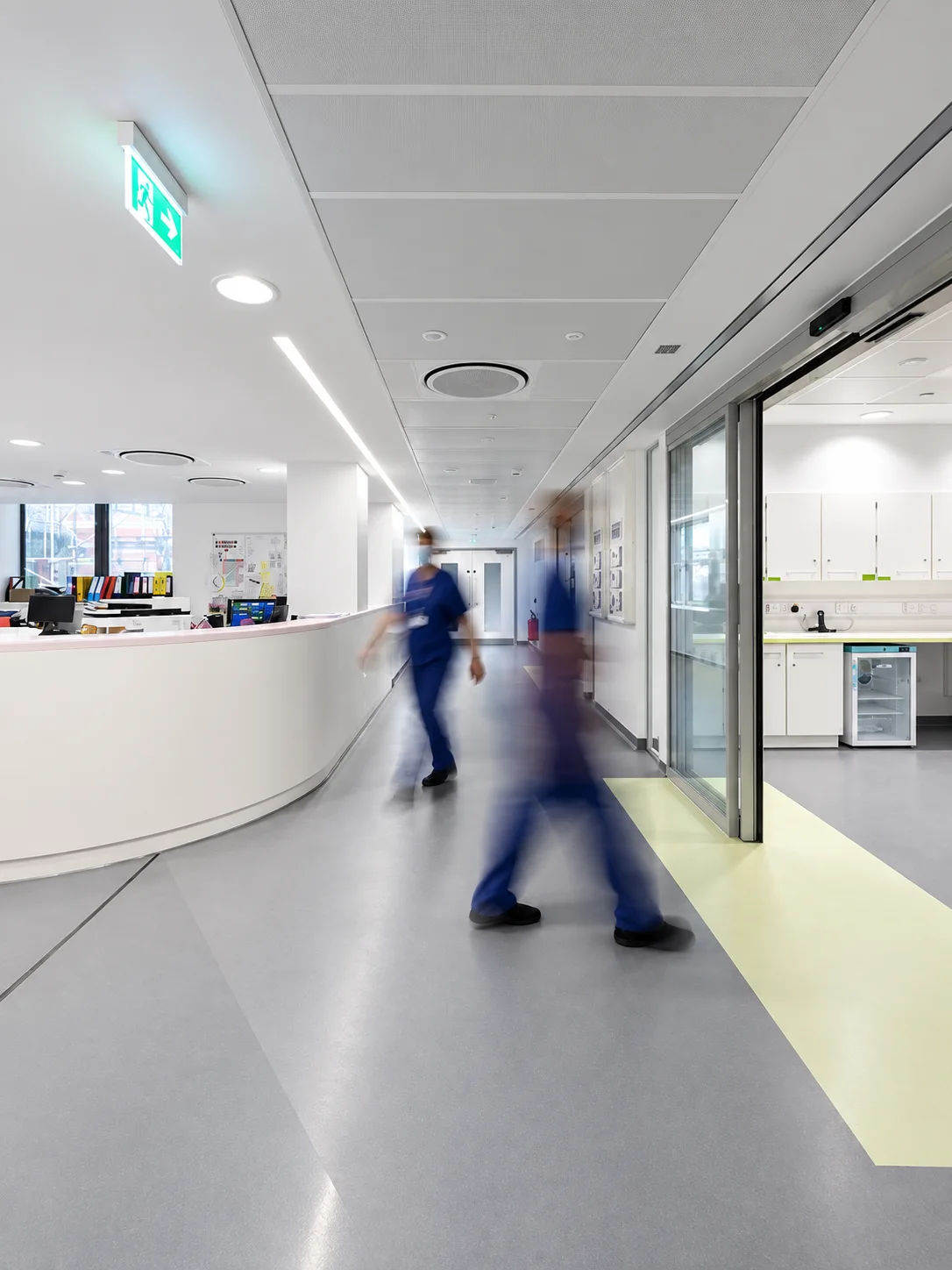
A hospital stay can blur the boundary between day and night. Patients may spend the morning far from a window, with little light reaching their eyes, then face corridor spill, screens and sudden overhead lighting when they are trying to sleep.
To the brain, those exposures are time signals. Light does more than make a room visible: it helps set the circadian system. Treating the environment as part of care therefore means asking more than whether a room looks bright. It means considering how much light reaches the patient’s eyes, at what time, for how long and with which spectrum.
The body needs a clear difference between day and night
Specialised cells in the retina send information about light and darkness to the brain’s master clock. That clock helps coordinate sleep and wakefulness, alertness, body temperature and melatonin release.
Timing changes what light does
Brighter, melanopically effective light can strengthen the daytime signal when delivered in the morning or during the day. The same exposure late in the evening or overnight can delay sleep or increase alertness. This is why the conversation cannot be reduced to “blue light is bad”. Intensity, spectrum, timing, duration, previous exposure and the patient’s position all influence the biological response.
Two rooms can measure the same illuminance on a desk while delivering very different light at the eye of someone lying in bed. An international expert consensus published in 2022 recommends brighter days, low melanopic exposure before bed and darkness during sleep for healthy adults. Those targets are useful design references, not ready-made prescriptions for older people, critically ill patients or every hospital ward.
What hospital studies actually show
The evidence is encouraging in places, particularly for sleep and circadian timing, but it is not uniform. Patient groups, lighting protocols and outcome measures differ substantially, making a universal formula impossible.
A systematic review of 29 hospital trials found favourable results in many studies assessing sleep, circadian alignment, fatigue or daytime mood. Effects on mood and cognition were inconsistent, however, and the evidence for naturalistic or dynamic lighting was not strong enough to establish one preferred approach.
In a 2025 study of 87 cardiology patients, programmed lighting that provided more daytime melanopic stimulation and reduced blue content in the evening was associated with 66 additional minutes of night-time sleep, an earlier rest–activity phase and better perceived alertness. That is a meaningful signal, but it does not prove that every dynamic lighting system will produce the same benefit in every clinical setting.
Evidence becomes less certain when the outcome is delirium. A 2026 systematic review and meta-analysis, covering eight studies and 1,190 participants, rated the certainty of evidence as very low and found that the effect of bright light therapy on delirium incidence remained uncertain. Likewise, a randomised trial involving 734 ICU patients found no significant reduction in delirium when dynamic lighting was used as a stand-alone intervention.
Sleep, mood and recovery are different outcomes
Sleep and orientation to time
This is where the research signal is most consistent. A distinct sequence—brighter day, gradual evening, dark night—may reinforce the sleep–wake cycle. Yet hospital sleep is also shaped by pain, noise, medication, anxiety, monitoring and illness. A review of 76 studies of non-drug sleep interventions reinforces the need for a combined approach rather than a single environmental fix.
Mood and the experience of care
Daylight, predictable transitions and some control over the room may make a stay feel calmer and easier to understand. But hospital trials do not show a uniform effect on anxiety, depression or cognition. A lighting system should not be marketed as reducing emotional distress for every patient unless that specific outcome has been demonstrated in the intended population.
Clinical recovery
Better sleep and a stable body clock are worthwhile outcomes in their own right, and they may create more supportive conditions for recovery. “May support” is not the same as “has been shown to accelerate”. Current evidence does not establish that lighting alone shortens admission, reduces complications or lowers medication use. The latest ICU lighting review reached the same broad conclusion: heterogeneous methods and incomplete reporting still prevent firm claims about clinical outcomes.
Design a 24-hour light pattern, not a miracle lamp
Circadian-supportive lighting is a combination of architecture, technology and care routines.
During the day
- Use daylight where possible while managing glare and heat.
- Deliver sufficient light at eye level, particularly in the morning.
- Align light with mobilisation, activity and clear time cues whenever the patient’s condition allows.
In the evening and overnight
- Step down intensity and melanopic stimulation gradually.
- Avoid using the general ceiling light for a small, local task.
- Provide directed task lighting for medication, examination and safe movement.
- Reduce corridor spill, reflections, flicker and bright sources within the patient’s field of view.
Across the care system
- Measure light vertically at the patient’s actual eye position, not only on a horizontal work surface.
- Record intensity, spectrum, timing and duration; correlated colour temperature alone is not a circadian dose.
- Combine lighting with noise reduction, clustering of overnight care and effective pain management.
- Keep changes gradual, reversible and easy for staff to override when care requires it.
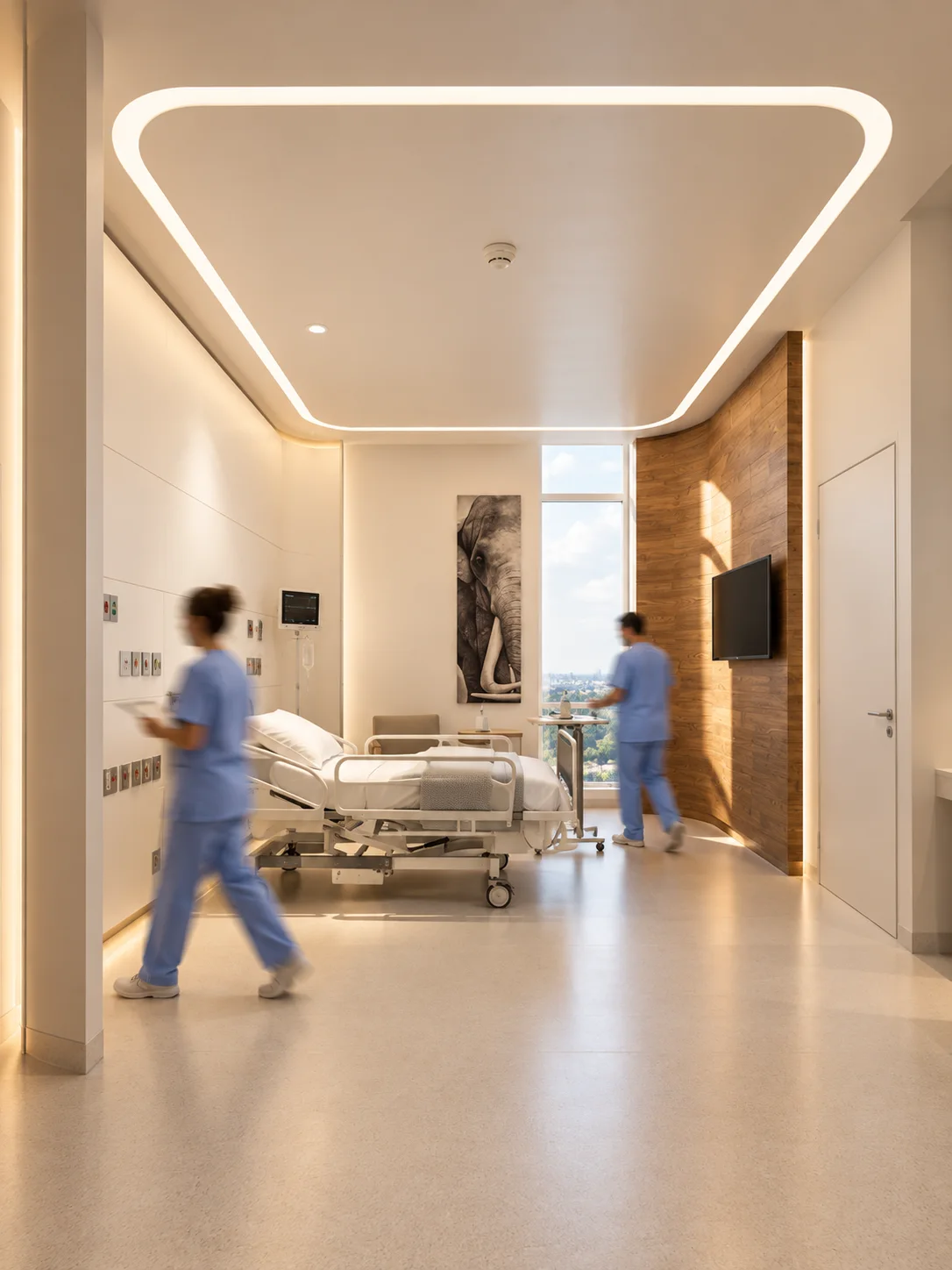
That is the logic of a patient-centred hospital room: protecting rest while preserving the conditions clinicians need to provide safe care.
Clinical safety comes first
Dimming a room must never increase the risk of falls, medication errors, missed observations or delayed emergency action. Any lighting strategy must retain adequate visibility and meet requirements for accessibility, infection prevention, clinical engineering, glare and flicker.
Environmental lighting should also be distinguished from therapeutic bright light. Bright light therapy needs clinical indication and monitoring, particularly for people with bipolar disorder or a history of mania, photosensitive migraine, eye disease or photosensitising medication. The ISBD clinical recommendations set out specific contraindications, adverse effects and monitoring for therapeutic use.
Individual response matters too. A schedule that is comfortable for one person may be unpleasant or mistimed for another. Patient preference, visual comfort, sleep and safety events all belong in the evaluation.
Better lighting respects the patient’s time
Hospital lighting is not merely decorative, but neither is it a cure. It is a modifiable part of the environment that can make daytime clearer, evening gentler and essential night-time care less disruptive.
The useful question is not simply “more light or less light?” It is which light does this person need, at this time, for this task? Sleep and patient experience can be measured from the first pilot. Claims about shorter stays, fewer complications or reduced medication should wait for well-designed comparative studies.
NeumaCare is exploring this approach through NC-Healthcare, bringing lighting together with other sensory variables. If your organisation would like to examine a pilot with defined outcomes and safety measures, start a conversation with us.
Frequently asked questions
Can hospital lighting disrupt a patient’s sleep?
Yes. Too little light during the day and unnecessary exposure at night can weaken the day–night contrast and fragment sleep. Pain, noise, medication, care interruptions and the patient’s condition also play major roles.
What is circadian or dynamic lighting?
It is lighting that changes in intensity and spectral composition over the day to create a brighter daytime signal, a gentler evening transition and a darker night. The label itself proves nothing; the actual exposure protocol must be described and measured.
Is warm light at night enough?
No. Perceived colour is only one factor. Light level at the eye, timing, duration, source position and the patient’s daytime exposure all influence the response.
Can better lighting prevent delirium or speed recovery?
That cannot currently be claimed in general. Findings on sleep and circadian alignment are promising, but evidence for delirium, length of stay and other clinical outcomes remains uncertain or inconsistent.
Is bright light therapy safe for every patient?
No. Therapeutic bright light requires clinical oversight and particular care in people with bipolar disorder, photosensitive migraine, eye disease or photosensitising medication. It should not replace established treatment or be introduced without a protocol.
Sources and further scientific reading
- Brown TM et al. (2022). Recommendations for daytime, evening, and nighttime indoor light exposure to best support physiology, sleep, and wakefulness. PLOS Biology.
- International Commission on Illumination (2024). CIE Position Statement: Proper Light at the Proper Time, 3rd edition.
- Lindskov FO, Iversen HK, West AS. (2022). Clinical outcomes of light therapy in hospitalized patients: a systematic review. Chronobiology International.
- Dunn AS et al. (2025). The impact of dynamic lighting on sleep timing and duration for hospitalised patients. Journal of Sleep Research.
- Moussa RS et al. (2026). Bright light therapy and circadian rhythm regulation for delirium prevention in hospitalised adults: a systematic review and meta-analysis. BMJ Open.
- Simons KS et al. (2016). Dynamic light application therapy to reduce the incidence and duration of delirium in intensive-care patients: a randomised controlled trial. The Lancet Respiratory Medicine.
- Linders IK et al. (2026). Lighting in intensive care units: a systematic review of patient outcomes and directions for future research. Intensive and Critical Care Nursing.
- Beswick AD et al. (2023). The effectiveness of non-pharmacological sleep interventions for improving inpatient sleep in hospital: a systematic review and meta-analysis. Sleep Medicine.
- Geoffroy PA et al. (2025). Light therapy for bipolar disorders: clinical recommendations from the ISBD Chronobiology and Chronotherapy Task Force.